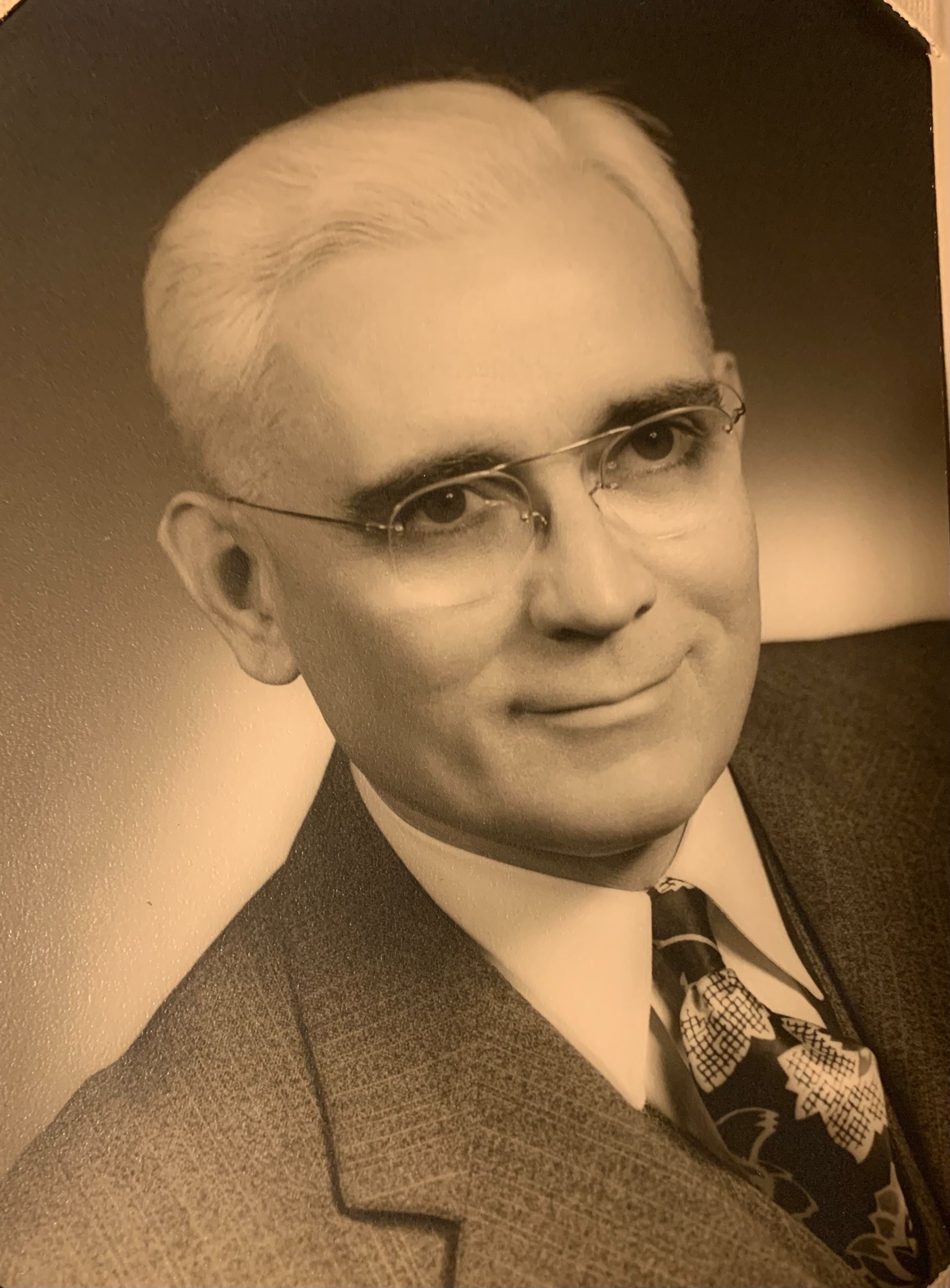
The Rev. William E. Ashbrook was born March 19, 1896, 128 years ago. He went to be with the Lord April 5, 1977. Ashbrook grew up in The United Presbyterian Church of North America (UPCNA), attended and graduated from Pittsburgh Theological Seminary, and was subsequently ordained in the same denomination.
In 1931 the UPCNA was considering merging with the Presbyterian Church of the United States of America (PCUSA; the merger eventually took place in 1958). Seven years earlier, in 1924, a formal statement signed by 1,274 PCUSA ministers was published, protesting the General Assembly’s requirement that candidates subscribe to the “five fundamentals” in order to be ordained. This statement of protest was called The Auburn Affirmation.
With this background, conservatives such as William Ashbrook were alarmed at the thought of the UPCNA merging with the PCUSA. Consequently, Ashbrook wrote an article to be published in the UPCNA’s official organ, “The United Presbyterian.” The editor refused to publish Ashbrook’s article on the grounds that it was “too long.”
Some years ago I came into the possession of many of Ashbrook’s files and correspondence, and that is the source of this hitherto unpublished article. The original document can be downloaded here. Statements I wanted to emphasize are in bold.
IS THE PROPOSED UNION DESIRABLE?
However much one may dislike controversy, there comes a time when one feels constrained to speak. With the prayer that my thoughts may in some sense be directed by the Holy Spirit, and that I may be led to speak in love, I should like to set down a few of my own convictions relative to the proposed union of the Presbyterian Churches.
The time has come when the real issues involved in such a union should be clarified. Having profited by the expressions of those who have already pointed out some of the dangers involved in the proposed union, we shall attempt to present a few additional facts. Let it be understood at the outset that we are not opposed to the principle of union. Any proposed agreement that promises to exalt the Lord Jesus Christ and strengthen the church’s testimony to the “faith once for all delivered to the saints” is not to be lightly considered. For such union the Master prayed. Issues far surpassing denominationalism are facing us today. That new alignments are inevitable within the next few years, we do not doubt, but that the proposed union of Presbyterian churches is of the Holy Spirit of God, we do seriously doubt. It is time that the entire United Presbyterian Church was giving serious consideration to a movement, for which according to our observation, there is but small enthusiasm on the part of the church as a whole.
We are living in a day when the great issues of Christendom must be fought out upon the field of faith versus infidelity. It is a well known fact today that many denominations and some churches within all denominations, have let down the bars until unbelief has come in like a flood. A generation or more ago the Paines and Ingersolls and their ilk went up and down the land inveighing against the Word of God and the doctrines which Christians held dear to themselves. They delivered their utterances from the public platform. Today many ministers clothed with the church’s garb proclaim the same teaching from many pulpits of our land. Now any proposed union which is likely to strengthen the church’s testimony in the face of present tendencies, suggests itself, upon the surface, as being probably desirable, but any proposed union that threatens to weaken our church’s witness to the fundamental truths of historical Christianity suggests itself as being highly undesirable. Judged in this light, what shall we say of the proposed affiliation of our church with other Presbyterian bodies? We shall write only of those things which pertain to the Presbyterian Church U.S.A., for we know comparatively little concerning the other parties to the proposed union. Will such a union exalt Jesus Christ and strengthen the church’s testimony?
It is our conviction that a small minority of our Presbyterian brethren are bearing a very fearless testimony for Christ today. They have spoken boldly and in no uncertain terms; but to stand for the faith and maintain their testimony they have been compelled to effect what amounts to a practical withdrawal from the jurisdiction of their own church. We have earnestly wished many times that these men represented the spirit and faith of the Presbyterian church as a whole. Suffice it to say our own fellowship has not produced such fearless and able testimony to Scriptural truth in our day, but that these men are a very small minority in the ministry of the Presbyterian church, we cannot doubt. They are to all practical purposes outcasts from the church’s ministry and how long they will be able to maintain their positions and stay in the Presbyterian fold remains to be seen. To be sure, some moderators and prominent leaders in their fold have been going about crying “Peace, peace” within the church, but the fact remains there is not now, and there never can be any peace between the two parties in the Presbyterian church. “Can two walk together except they be agreed?”
We have read with a smile the articles which have appeared from time to time calling attention to the doctrinal basis for the proposed union. We have observed the attempt to cite and maintain all the pronouncements of all the churches involved as a basis for agreement in matters of faith. Evidently it is necessary to insert many planks in the platform so that it may be broad enough for all. Politicians build platforms like that, but good and all as the pronouncements of Westminster divines, and Synods of Dort, and what not may be in and of themselves, what do they amount to for practical purposes? Do they effectively safeguard the church’s teaching? Can they guarantee the purity of the gospel which this new church would preach? Far from it. For that purpose they are of no more value than scraps of paper. We could cite many ministers and many theological seminaries that have junked the Bible and its message of saving grace, but they hold to Westminster standards tenaciously. “By their fruits ye shall know them”. A church’s position today must be judged by the pronouncements of its leaders, by the action of its courts, by the teaching of its schools and by the message of its pulpits. Judged by these things does the Presbyterian church commend itself to us as a body of evangelical believers with whom we can enjoy happy and unbroken fellowship in Christ? Will union with such a body strengthen or weaken the church’s testimony? Remember it is not size, or wealth, or organization that constitutes a church that God can bless. The church at Laodicea had all of these but it did not have the Spirit’s blessing.
Turning aside from doctrinal standards, what do we see when we observe the life of the Presbyterian church as a whole today? Are its schools safe for our children? Are its seminaries loyal to the Word of God? The writer does not know the church as a whole, to be sure, but he does not know of a single Presbyterian college or seminary where he would care to send his children, unless he wished to take serious chances at having their faith destroyed. One of the Presbyterian colleges in Ohio recently invited a prominent student worker, whose departure from the Bible as the Word of God is well known, to lecture to its students. Some of the advice he gave to students would not be fit subject matter to print on this page.
Many mis-representations [sic] have been given of the Princeton matter but those who have ears to hear and eyes to observe know that the essence of the Princeton controversy was faith versus liberalism. Princeton was recognized throughout the land as the one remaining bulwark of evangelical strength in the Presbyterian church. What reasons did the men, whose records for sound scholarship and fearless testimony are well known, give for withdrawing from Princeton? They testified to a man that it was faith that was being so vigorously assaulted at Princeton. Many attempts have been made to cloud that issue. Various reasons have been advanced for the changes that were made, but a study of the leadership involved will soon convince any impartial observer that it was antagonism toward Princeton’s evangelical position that brought the assault. Many members of Princeton’s present faculty are talking overtime to convince the church that the faculty is as sound as it ever was; but they are not telling the church that on Princeton’s Board of Control there are men today who have gone on record as denying the fundamental truths of the New Testament. The Board of Control, and not the present faculty, will determine what the Princeton of tomorrow will be. Be sure of this, men of such scholarly attainments and consecrated ability as Drs. Wilson, Machen and Allis did not feel compelled to withdraw from Princeton without a reason vastly larger than the petty excuses offtimes [sic] advanced to account for their departure. One could say a great deal more concerning the other seminaries under the control of the Presbyterian Church.
When one considers the attitude of recent General Assemblies toward matters of faith, one has his convictions strengthened as to the trend of affairs in the Presbyterian Church today. A number of years ago Presbyterian Assemblies could deal with such matters as Union Seminary’s departure from the faith. Even in more recent years a sizable and vigorous protest could be made against those who rejected apostolic Christianity; but the spirit and the utterances of recent Assemblies indicate how far things have moved within recent years. No better indication of this can be cited than the following extracts taken from The Union Seminary Alumni Bulletin:
“The General Assembly of the Presbyterian Church in the U.S.A. at Cincinnati was a happy occasion undisturbed by such heated discussions and acrimonious debates as have marred recent meetings of that body. Even the presence of some thirty or more Union graduates as commissioners did not create so much as a ripple on the surface of the peaceful waters Union men were gratified at the manner in which President Coffin’s address was received, when he reported on his visit to the reunion of the Scottish Churches as a delegate from the Presbyterian Church. A local news report from the Cincinnati Times Star thus describes the scene:
“‘…This big body shows what it thinks by the way it bestows or reserves its applause…Thus, all unpredictably, it bestowed its accolade upon President Henry Sloane Coffin, of Union Theological Seminary, New York. He bad made a brilliant news report of the recent reunion of the Scottish Churches, to which he was a official delegate. His portrayal was adequate to the historic occasion, and shot through with flashes of interpretive comment. The Assembly was both inspired and instructed.
“‘As Dr. Coffin finished he was given a salvo of applause. Then apparently remembering the bard knocks that have in the past been given to Union Seminary, the commissioners decided to show the president what they now think of him, and the burst of applause swelled into a sustained ovation, the highwater mark of Assembly approval to date. …One came away from the Assembly with the feeling that a new day has set in for the Presbyterian Church, that it is determined to forget the things which are behind and press forward with united front to accomplish its great tasks for the Kingdom.’”
Perhaps the General Assembly of the Presbyterian Church regards such broadmindedness as something highly commendable, but for ourselves, are we ready to swallow Union Seminary with its blasphemous denials of all that we as evangelical believers hold near and dear to us? Would union with a body that gives its approval to such things exalt Jesus Christ? Could it be in any sense desirable?
And then what about our missionary enterprises? Would our testimony to Christ’s saving power be strengthened by such a union? However loyal to the truth the leaders of the Presbyterian Foreign Board may profess to be, they certainly have grown accustomed to frowning on things which we have been accustomed to stress in our missionary enterprises. They encourage things which we would not knowingly tolerate. Many good Presbyterians have protested again and again against the actions of their Foreign Board. A number of years ago a group of missionaries in China, sensing the dangers involved with the encroachments of modernism in their field, united to form The Bible Union of China. The purpose of the Bible Union was to foster and encourage the proclamation of a sound gospel message, and to guard against the poison of infidelity in their midst. The Presbyterian Board frowned upon the enterprise and let it be known that their policy in China was broad enough to include men and women of widely divergent views.
Lest anyone think that things have improved with the Presbyterian Foreign Board, let them consider a recent selection of this body. There is a fund in the Presbyterian Church which is known as the “Joseph Cook Lectureship Fund.” The income from this fund is used to found and maintain learned and evangelical lectures in India and China and Japan. The Board uses the income from this fund to send someone abroad to lecture in these countries every few years. Presumably they are to represent the Christian religion as held and propagated by the Presbyterian Church U.S.A. It is a very choice honor and prize to be bestowed by the Foreign Board. The man chosen for the post this year is a young minister from Columbus. Lest we be accused of saying something unkind about our fellow townsman, we will let a recent editorial in The Presbyterian speak:
“It would seem fitting that the one chosen to represent us on this important mission should be an outstanding man, ‘learned and evangelical.’ We can scarcely associate the name of Joseph Cook with any other sort of man. …There are plenty of men in our church who by many years of service have proven themselves to be learned, staunchly evangelical and outstanding in their work as pastors and teachers. Word comes to us that the one chosen this time makes no claim to be thoroughly in harmony with our Standards as repeatedly interpreted by the General Assembly….We must dissent from the selection made by the Board, which is supposed to represent us all.”
Will the cause of missions be advanced by such actions? Did our church have to blush for shame for her Missionary record in the days when she was a much smaller body than she is today? She was not as broadminded then as now, but the Spirit of God blessed our testimony to the lost in those days. Has God refused to bless the missionary efforts of such bodies as the Moravians and The Christian and Missionary Alliance just because they are small? Surely the cause of missions could not be advanced by a move that would only introduce the virus of modern unbelief into our veins. We write out of no sense of self righteousness. We cannot lay claim to bearing a testimony that is 100 percent pure, but our Foreign Board has not yet come to the place where it frowns on gospel truth and encourages the sowing of doubtful seed.
And now a word about the ministry of the Presbyterian Church. We have already referred to the men who are speaking fearlessly within that body. We greatly admire them. They preach Jesus Christ and Him crucified as the one and only hope for sinners, but are they in the majority so far as the leadership of that church goes? Far from it. They are ridiculed and maligned in their own church. It is an easy matter to proclaim to us that at least ninety percent of the ministry of the Presbyterian church is theologically sound. One might think so if he lived in Pittsburgh. One cannot think so if he lives in some other localities.
But what are the facts? Aside from local observations, how do their men go on record in matters of belief? In every recent test in the Presbyterian General Assembly the men who have attempted to maintain the faith have been sorely in the minority. To be sure there are many middle-of-the-road men in every church. They do believe, but like Peter in the judgment hall, they are afraid to say so loud enough for anyone to hear. But I have before me as I write, a record of some thirteen hundred ministers in the Presbyterian Church who have declared just where they stand, in language that cannot be easily mis-understood.
In 1924 a paper was presented to the Presbyterian General Assembly which came to be known as The Auburn Affirmation. This paper was in the form of a protest against earlier actions of the Assembly in attempting to deal with the Fosdick case. Stripped of its legal technicalities and camouflage, this paper states that it is the conviction of its signers that a man to be a minister in the Presbyterian Church does not need to believe in any one, much less all, of the distinctive doctrines of the New Testament. To be explicit, some thirteen hundred Presbyterian ministers have gone on record as saying that a man does not need to believe in the infallibility of the Scriptures, the virgin birth, the sacrificial atonement, the bodily resurrection of Christ, or the reality of miracles, in order to be ordained to the ministry of the Presbyterian Church. The signers of this document make the plausible claim also, that besides the signers there are hundreds of other ministers who approve of the Affirmation, though they have refrained from signing it. One might go on to cite conspicuous examples of outstanding men in the Presbyterian Church who have departed from a belief in New Testament Christianity; but for our purpose, enough has been said. ·While listening to the pleas of those who urge the advantages of a united front in advancing the Kingdom, let us keep these facts in mind and ask whether or not the Holy Spirit is likely to bless such a union.
During the last few years the morale and loyalty of our membership has been seriously impaired by continued talk of church union. We know of some who are withholding their means until they are able to discern what the issues of these things will be. We have viewed with much sadness of heart the willingness of many of our ministers to find the fullest and easiest fellowship with those who have made travesty of the Gospel. It is not the flock that has strayed, but rather the shepherds. Many apparently have lost the faculty for which Paul prayed when he asked that his Phillipian [sic] friends might be able to distinguish between the things that differ. Call such a position narrowminded if you will, but we are reminded that Paul was utterly intolerant of any man who preached any other gospel than the gospel which he preached. Let us not forget for a moment that our church has traveled far in imitating the spirit of others. Continuance in that direction means that our United Presbyterian Church has no further mission to the world; but a rededication to the proclamation of the simple gospel of saving grace to the exclusion of every other, will bring back to us the blessing of God which drives and conferences and appeals will never bring.
There are many ministers in the United Presbyterian Church and many good and conscientious men too, who will utterly disagree with the positions taken by the writer. To many, the things mentioned above are not of sufficient import to defer union. They see no reason for our continued separate existence. We hold no malice toward those who differ with us. We only wish the way might be prepared for them to go peaceably and with such property adjustment as would be both wise and just. A realignment all around would probably be a wholesome thing for the church but let the division be on the ground of liberalism as over against conservatism. Quoting the words of another rather freely, “We see heartsearching [sic] days ahead and it is not too much to predict that if there comes a union movement here like the tragedy in Canada, there will come out of the welter a continuing church, call it what you will, but a church purged and chastened in numbers and worldly power but closer to the real needs of sinners and more confident in the power, glory and sufficiency of the Lord of the Church.” It will be our prayer if that day comes that those of our brethren in the Presbyterian Church who believe in the gospel of redeeming grace, as opposed to the social gospel and the humanized Jesus, will find fellowship with us, through which we can continue to proclaim a message that God can bless.
The talk of union will continue until the issues are finally settled. The peace and efficiency of the church will be impaired until that time. The Federal Council of Churches, sold to the social gospel and the Christ of human invention, will continue to agitate it in every communion. Every such proposed union is nothing short of a compromise. Already we feel the need of bringing every conviction and every belief into the common hopper to have an edge rubbed off here and a corner there. There are some in our church who cannot and will not accept the banner of compromise. If we have a message in any sense worthwhile it must be a message we are willing to die for if need be. We cannot find peaceful and happy fellowship with those who hold to beliefs so radically different from our own. Two cannot walk together except they be agreed. May the Spirit of God frustrate the plans of men if need be, to bring out of the present confusion and uncertainty a closer union of those who proclaim the old gospel of redeeming grace through the crucified and risen Lord. No other union can be in any sense desirable for those who believe in apostolic Christianity.
 Dan Greenfield